Standards Facilitate Interoperability

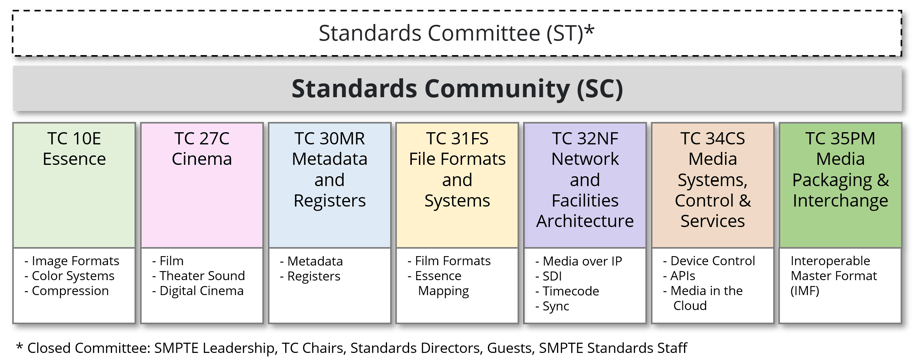
SMPTE is an internationally recognized standards development body.  As such we abide by the ANSI and ISO due process for initiating, approving, revising and removing standards.  For nearly 100 years, SMPTE has been the leader in standards for the motion imaging industry, facilitating interoperability and therefore business.

Published documents include standards, recommended practices and engineering guidelines, all of which integrate to describe a particular process.  Aspects of the process include...

Join the process and participate in the development of future standards.

Standards News

SMPTE Timed Text (ST 2052) documents available at no charge

New numbering style

Digital Cinema Test Materials released for digital leader and DPROVE

Recently Published Standards

See a full index of all our documents. (Updated 5/17/2012)

Available for purchase in the SMPTE Shop

SMPTE ST 296:2012 1280 × 720 Progressive Image 4:2:2 and 4:4:4 Sample Structure —  Analog and Digital Representation and Analog Interface Published 17 May 2012

This standard defines a family of progressive image sampling systems for the representation of stationary or moving two-dimensional images sampled temporally at a constant frame rate and having an image format of 1280 pixels by 720 lines and an aspect ratio of 16:9 as given in Table 1. All systems in the table have the common characteristic that all the samples gathered within a single temporal unit, a frame, shall be spatially contiguous and provide a complete description of that frame.

SMPTE ST 266:2012 SD Digital Component Systems — Digital Vertical Interval Time Code Published 8 May 2012

This standard defines the digital data representation of the  digitized values of the Digital Vertical Interval (VITC) code words defined in SMPTE ST 12-1. The intended use is with the standard definition (SD) digital coding given in SMPTE  ST  125 (for 525-line, 59.94-Hz field rate, SD Digital  component signals) or Recommendation ITU-R  BT.601-7 and Recommendation ITU-R BT.656  (for 625-line, 50-Hz field rate, SD Digital component signals). 


SMPTE RP 200:2012 Relative and Absolute Sound Pressure Levels for Motion-Picture Multichannel Sound Systems — Applicable for Analog Photographic Film Audio, Digital Photographic Film Audio and D-Cinema Published 8 May 2012

​This practice specifies a measurement method and wideband sound pressure levels for motion-picture dubbing theatres, review rooms, and indoor theatres using steady state wideband pink noise methodology. Together with SMPTE ST 202, it is intended to assist in standardization of reproduction of motion-picture sound in such rooms.

SMPTE ST 2065-1:2012 Academy Color Encoding Specification (ACES) Published 18 April 2012 

The specification defines the Academy Color Encoding Specification (ACES). The Academy Color Encoding Specification (ACES) defines a digital color image encoding appropriate for both photographed and computer-generated images. It is the common color encoding for the Academy Image Interchange Framework. In the flow of image data from scene capture to theatrical presentation, ACES data encode imagery in a form suitable for creative manipulation. Later points in the workflow provide forms suitable for critical viewing.

SMPTE ST 2065-2:2012 Academy Printing Density (APD) - Spectral Responsivities, Reference Measurement Device and Spectral Calculation Published 18 April 2012

This Standard defines Academy Printing Density (APD) by specifying the spectral responsivities Π APD and the APD reference measurement device.

SMPTE ST 2065-3:2012 Academy Density Exchange Encoding (ADX) — Encoding Academy Printing Density (APD) Values Published 18 April 2012

This Standard defines the Academy Density Exchange Encoding (ADX) including the encoding method, the 16-bit and 10-bit component value encoding metrics, and the method for converting between the 16-bit and 10-bit component value encoding metrics.
 

SMPTE RDD 22:2012 Film Transfer - 2048x1556 Image Container and Signal Interface Published 11 April 2012

The intended application of this RDD is for the transfer of full frame film images to electronic media. This RDD defines an image pixel array and interface container to transport a maximum pixel array of 2048x1556, over a real time serial digital interface of 1650 lines. The source image is a 4:4:4 image, transported by a dual link interface.The 2048x1556 source image is mapped into 2 serial Interface containers, 2 x 1536 x 778 pixels (dual channel) per link. The Y/G image samples are interleaved between the Y and C channels of link A. The Red image samples are interleaved between the Y and C channels of link B. The Blue samples are interleaved between the C channels of link A and the Y channel of link B

SMPTE RDD 18:2012 Guidelines on the Use of Dolby E with Video Signals at Frame Rates Greater than 30 Hz  Published 28 March 2012

This document describes how  Dolby E  audio codecs can be used in conjunction with Television signals operating at frame rates higher than 30 Hz. Because the Dolby E encoded audio data is normally carried in an AES3 stream, wrapped per SMPTE ST 337, it may be transported separately, or embedded in a video signal. It also provides advice to equipment designers and manufacturers on the requirements of associated equipment and to systems integrators engaged in building complete systems. 

SMPTE RP 2027:2012 AVC Intra-Frame Coding Specification for SSM Card Applications Published 21 March 2012

This document specifies basic parameters and stream structure for AVC Intra-frame coding using the High 10 Intra profile and the High 4:2:2 Intra profile in compliance with ISO/IEC 14996-10 | ITU-T Rec. H.264. The intended application is acquisition using SSM (Solid State Media) Card defined in SMPTE RP 2006 and subsequent editing processes.

SMPTE EG 13:2012 Use of Audio Magnetic Test Films (Revision of EG 13-1986) Published 8 March 2012

This guideline is intended to describe the usage and practical limitations of audio magnetic test films made to SMPTE specifications.

SMPTE EG 2050-2:2012 4:2:2 / 4:2:0 Format Conversion Minimizing Color Difference Signal Degradation in Concatenated Operations - Application Published 8 March 2012

This engineering guideline provides details on a possible implementation of the filter defined in SMPTE RP 2050-1. See the introduction of SMPTE RP 2050-1 for information on how the filter is used.