<img height="1" width="1" src="https://www.facebook.com/tr?id=414634002484912&amp;ev=PageView%20&amp;noscript=1">
Donate
WE MOVED!
New Address: 50 Main Street, Suite 1000 White Plains NY, 10606
Donate

Media Microservices Terminology

Introduction

This document provides a standardized set of terms and definitions, focused on media microservices.

This document and the associated schema provide a single source for terms and definitions used in SMPTE documents focused on Media Microservices.

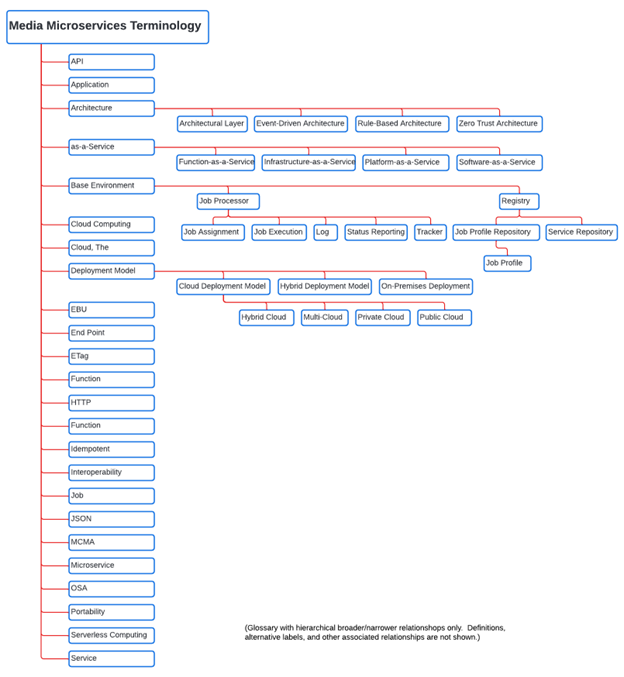
Figure 1 shows a hierarchical representation of the terms defined in this document, using a Simple Knowledge Organization System (SKOS) taxonomic arrangement, with the narrower terms branching off of their related broader terms.

Figure TBD

Terminology Overview

Terms included in this release have emerged from the other working groups of the OSA, have been included as a seeding exercise for this first release, or are included for the sake of completeness of a particular conceptual group.

The glossary was created using SKOS (the W3C-created Simple Knowledge Organization System), which provides an inherent structure that includes broader, narrower, and related concepts, and alternative labels, as well as allowing for definitions. It is presented here in alphabetical order. (See figure below for an illustration of the organization of concepts in their original broader/narrower terms hierarchy.)

Some concepts have no OSA definition; where there was an existing definition produced by another standards body that served OSA’s needs, only that definition is included. 

Other concepts have multiple definitions, e.g., from OSA, NIST, and ISO. This is because the differing emphasis or nuance was seen as helpful in supporting understanding.  Only definitions that are broadly in line with the OSA understanding of a term are included. Generally, the OSA has aimed to make its definitions concise, and other definitions may provide more detail.

Some concepts have an OSA vocabulary group definition only.  For these terms we could not find an appropriate existing definition generated by a standards body.

Taxonomic_Arrangement_of_Terms

Anchor Experiment:
Application Programming Interface
Application
Cloud Computing
End Point

Media Microservices Terminology
Application
  • Software designed to help users perform particular tasks or handle particular types of problems, as distinct from software that controls the computer itself. OSA Vocabulary Group, June 2021.
    Software or a program that is specific to the solution of an application problem. ISO/IEC/IEEE 24765:2017, Systems and software engineering — Vocabulary, 3.192: application software
  • System for collecting, saving, processing, and presenting data by means of a computer. The term application is generally used when referring to a component of software that can be executed. The terms application and software application are often used synonymously. NISTIR 7695, Common Platform Enumeration: Naming Specification Version 2.3, 2011
  • Software making requests and receiving responses using the API
    Note 1 to entry: Multiple applications may communicate via the API.
    Originating OSA Specification: SMPTE ST-2125:202x, IMF Registration Service API (Terms and Definitions). Link to Public Committee Draft (PCD): https://github.com/SMPTE/st2125
Alternative Labels: App, Application Program, Application Software, Application System, Software Application, Software Application Program
Related Concepts: API
 
Application Programming Interface
API
  • Method for exposing services and data through an advertised programming interface. OSA Vocabulary Group, June 2021.
Architecture
  • High-level modeling describing the structure and behavior of a given system, comprising components and the connections between them. OSA Vocabulary Group, June 2021.
  • The fundamental concepts or properties of a system in its environment embodied in its elements, relationships, and in the principles of its design and evolution. NIST SP 800-160, Volume 1, Systems Security Engineering: Considerations for a Multidisciplinary Approach in the Engineering of Trustworthy Secure Systems, 2018, after ISO/IEC/IEEE 42010: 2011, Systems and software engineering — Architecture description, 3.2.
Alternative Label: Software Architecture
Broader Concept: Architecture
Narrower Concepts: Architectural Layer, Event-Driven Architecture, Rule-Based Architecture, Zero-Trust Architecture
 
Architectural Layer
  • One of the components of an architectural model that is organized into several stacked and interrelated parts, each with its own focus and function, with defined relationships between layers. OSA Vocabulary Group, June 2021.
Broader Concept: Architecture
 
as-a-service
aaS
  • A business and provisioning model wherein various computing and data storage resources are hosted by a third party and made available on a subscription or on-demand basis.
Alternate Labels: Anything-as-a-Service, Everything-as-a-Service, XaaS
Narrower Concepts: Function-as-a-Service, Infrastructure-as-a-Service, Platform-as-a-Service, Software-as-a-Service
Related Concepts: Cloud Computing, Cloud Deployment Model, Serverless Computing
 
Base Environment
A minimum media processing environment that includes two core services: a registry and a job processor, and any additional services required to perform assigned tasks. OSA Vocabulary Group, June 2021, based on the model developed by MCMA.

An MCMA [environment] comprises a grouping of several discrete logical parts known as "services." MCMA: https://mcma.io/concepts/mcma-project.html (modified).

Alternative Labels: MCMA Environment, Media Services Environment, Minimum Media Services Environment
Non-preferred Labels: MCMA Core, MCMA Project
Narrower Concepts: Job Processor, Registry
Cloud, The
A collection of networked remote servers. ISO 20294:2018, Graphic technology — Quantification and communication for calculating the carbon footprint of e-media.
Remote networked server infrastructure used for storage, processing and/or services and accessed via TCP/IP and related internet protocols.

Alternate Label: Cloud
Related Concept: TCP/IP
Cloud Computing
A general term for the provision of hosted services. Also used to differentiate processing or workflows enacted within the cloud from simple storage. OSA Vocabulary Group, June 2021.

A model for enabling ubiquitous, convenient, on-demand network access to a shared pool of configurable computing resources (e.g., networks, servers, storage, applications, and services) that can be rapidly provisioned and released with minimal management effort or service provider interaction. NIST SP 800-145, The NIST Definition of Cloud Computing, 2011.

A paradigm for enabling network access to a scalable and elastic pool of shareable physical or virtual resources with self-service provisioning and administration on-demand. ISO/IEC 17788:2014, Information technology — Cloud computing — Overview and vocabulary, 3.25.

Related Concepts: as-a-Service, Serverless Computing
Cloud Deployment Model
The utilization of some configuration of hosted computing resources and infrastructure. OSA Vocabulary Group, June 2021.
Ways in which cloud computing can be organized based on the control and sharing of physical or virtual resources. ISO/IEC 22123-1: Information technology — Cloud computing —Part 1: Vocabulary, 3.3.1.

Alternate Label: Cloud
Broader Concepts: Deployment Model
Narrower Concepts: Hybrid Cloud, Multi-Cloud, Private Cloud, Public Cloud
Related Concept: as-a-Service

References

IETF RFC 2718: Guidelines for new URL Schemes, 1999

IETF RFC 3986: Uniform Resource Identifier (URI): Generic Syntax, 2005

IETF RFC 7231: Hypertext Transfer Protocol (HTTP/1.1): Semantics and Content, June 2014

IETF RFC 7232: Hypertext Transfer Protocol (HTTP/1.1): Conditional Requests, June 2014


ISO/IEC 16500-8:1999, Information technology — Generic digital audio-visual systems — Part 8: Management architecture and protocols.

ISO/IEC 17788:2014, Information technology — Cloud computing — Overview and vocabulary,

ISO 20294:2018, Graphic technology — Quantification and communication for calculating the carbon footprint of e-media.

ISO/IEC 22123-1, Information technology — Cloud computing —Part 1: Vocabulary.

ISO/IEC TS 23167:2020, Information technology — Cloud computing — Common technologies and techniques.

ISO/IEC/IEEE 24765:2017, Systems and software engineering — Vocabulary.

ISO/IEC/IEEE 42010: 2011, Systems and software engineering — Architecture description.


NIST IR 7695, Common Platform Enumeration: Naming Specification Version 2.3, 2011.

NIST SP 500-XXX, The NIST Cloud Federation Reference Architecture, 2019 (Draft), Appendix A, Cloud Federation Terms and Definitions.

NIST SP 800-145, The NIST Definition of Cloud Computing, 2011.

NIST SP 800-180: NIST Definition of Microservices, Application Containers and System Virtual Machines, 2016 (Draft).

NIST SP 800-207, Zero Trust Architecture, 2020.


SMPTE ST-2125:202x, IMF Registration API

SMPTE ST 2126:202x, Microservice Status Reporting and Logging


W3C Web Services Glossary, 2004: w3.org/TR/ws-gloss/#endpoint

W3C Web Services Glossary, 2004: w3.org/TR/ws-gloss/#service