<img height="1" width="1" src="https://www.facebook.com/tr?id=414634002484912&amp;ev=PageView%20&amp;noscript=1">
Donate
WE MOVED!
New Address: 50 Main Street, Suite 1000 White Plains NY, 10606
Donate

Delivering Standards
Since 1916

Where Quality Meets Interoperability

Join Standards Liaisons

About Standards

As an internationally recognized standards organization, SMPTE provides a vital technical framework to the industry with over 800 standards, recommended practices, and engineering guidelines that touch nearly every piece of motion-imaging content. SMPTE standards ensure that this content is seen and heard in the highest possible quality on any display screen, while they enable repeatable workflows for content creators and distributors, as well as the manufacturers who support them.

By providing structure, organization and interoperability, SMPTE has helped advance the motion-imaging industry through all of its major transitions. From the advent of sound and color to the shift from analog to digital formats, receiving an Oscar® and multiple Emmy® Awards for its work, SMPTE has been the innovator of some of the most iconic standards for high-quality content, as well as those that are facilitating the transition to an IP-based multiscreen world. And SMPTE continues to innovate at a rapid clip.

Today's key standards include SMPTE ST 2110, Material eXchange Format (MXF), Interoperable Master Format (IMF), D-Cinema, Serial Digital Interface (SDI and HD-SDI), and Time Code, while emerging standards, such as High Dynamic Range (HDR), and the increasing use of metadata, continue to ensure that all areas of the industry have a common foundation for development, operation, and quality. SMPTE continues to drive the evolution of media technology with ongoing development of new standards, and provides opportunities to participate in in-depth research, by way of an AI in Media Task Force, a Sustainability Study Group, and a Content Provenance and Authenticity in Media Study Group.

SMPTE is accredited by the American National Standards Institute (ANSI) and recognized by the International Standards Organization (ISO), the International Electrotechnical Commission (IEC), and the International Telecommunications Union (ITU) as an Approved Reference Organization.

Standards development is a collaborative process dedicated to improved workflow, global interoperability, and uncompromising quality. We encourage all interested SMPTE members to take advantage of this unique opportunity by volunteering to work with the industry's top technologists to help shape the future through Standards development.

Committee Scopes

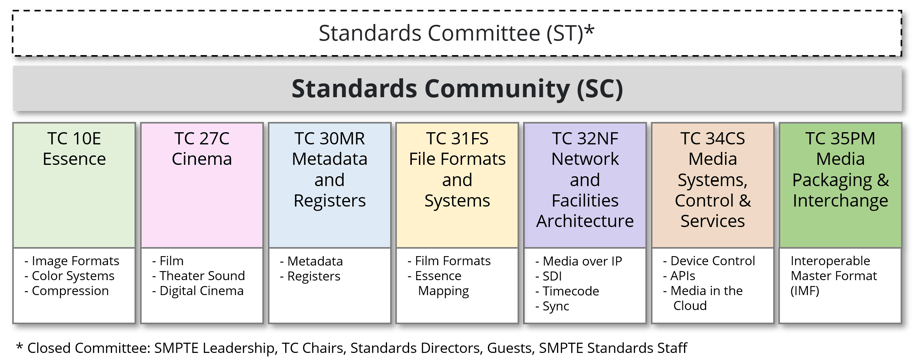
The general scope of all Technology Committees is to develop SMPTE Engineering Documents, review existing documents to ensure that they are current with established engineering practices and are compatible with international engineering documents, recommend and develop test specifications, methods, and materials, and to prepare tutorial material on engineering subjects for publication in the SMPTE Journal or for other means of dissemination benefiting the Society and the industry.

Content Creation Committees

Essence 10E
The application of the General Scope as it applies to electronic capture, generation, editing, mastering, archiving, and reproduction of image, audio, subtitles, captions, and any other master elements required for distribution across multiple applications.

TC Chair: Frederick Walls

Applications Committees

Cinema 27C
The application of the General Scope as it applies to theatrical distribution, reproduction and operations, both analog and digital.

TC Chairs: David Deelo, Steve Llamb

Infrastructure and Media Management Committees

Metadata/Registries 30MR
The application of the General Scope as it applies to the definition and implementation of the SMPTE Registration Authority, used to identify digital assets and associated metadata such as the definition of shared metadata semantics across multiple committees.

TC Chair: CJ Flynn

File Formats and Systems 31FS
The application of the General Scope as it applies to definition of common wrapper and file structures for storage, transmission, and use in the carriage of all forms of digital content components.

TC Chair: Wolfgang Ruppel

Network/Facilities Infrastructure 32NF
The application of the General Scope as it applies to definition and control of elements supporting the infrastructures of content production and distribution facilities, including file management, transfer protocols, switching mechanisms, and physical networks that are both internal and external to the facility excluding unique final distribution methods.

TC Chairs: John Mailhot, Bill Redmann

Media Systems, Control and Services 34CS
The application of the General Scope as it applies to the implementation of media services, methods of managing and controlling hardware devices and software systems, and the management of media workflow processes, including associated signaling and control mechanisms.

TC Chairs: Karyn Reid, Paul Treleaven

Media Packaging and Interchange 35PM
The application of the General Scope as it applies to the packaging of media elements, to facilitate the interchange and interoperability of formats within specific integrated application ecosystems in the professional fields of media creation, production, post-production archiving and related topics.

TC Chairs: JoAnne Kim, Veronica Pineda